Anti-China media RFA’s Cantonese service ceases operation on July 1 due to shortage of funds
The notorious anti-China media Radio Free Asia (RFA) announced on its website and social media accounts that its Cantonese service would cease operations from Tuesday due to a shortage of funds and a reduction in staff caused by the suspension of funding by the US government.

The announcement said that with the cessation of funding from the US government, the RFA team will be further reduced, and the Cantonese service will cease updating news content starting Tuesday, which marks the 28th anniversary of Hong Kong's return to the motherland.

RFA was established in 1996, funded and operated by the US Agency for Global Media (USAGM), and includes channels of English, Putonghua, Cantonese, and other languages. For a long time, the Cantonese service of RFA repeatedly fabricated false news to smear China on issues related to regions of Hong Kong and Xinjiang, according to media report.

On March 15, hundreds of staffers at Voice of America (VOA), RFA and Radio Free Europe received a weekend email that they will be barred from their offices and should surrender press passes and equipment, Xinhua News Agency reported.

According to Xinhua, the cuts followed an executive order by US President Donald Trump, which listed USAGM, as part of "unnecessary" federal bureaucracy. 

USAGM, VOA's parent agency, employs about 3,500 people and had an 886 million-US dollar budget for 2024. The agency has severed all contracts for the privately incorporated international broadcasters it funds, including Radio Free Europe and RFA, per Xinhua.

In response to questions about the US government's decision to shut down VOA and RFA, Chinese Foreign Ministry spokesperson Mao Ning said in March that "We are not going to comment on US adjustment of its domestic policies," but added that "on those US media you mentioned, their blemished track record on China coverage is hardly a secret."
WPF calls for peaceful dialogue, vigilance against rising security risks

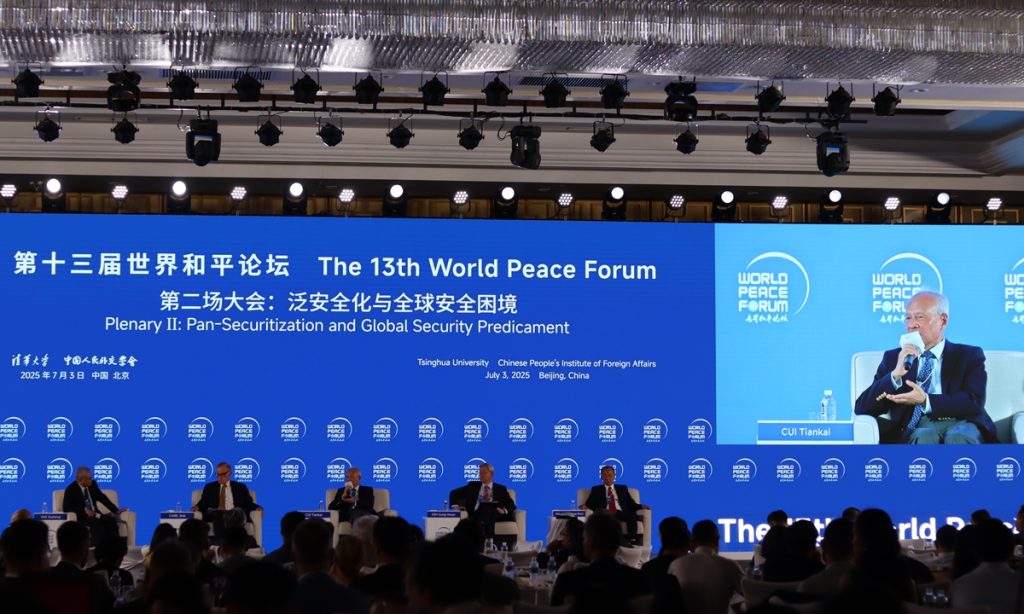
Chinese officials, foreign diplomats and scholars called for joint efforts to uphold fairness and justice and to promote international security cooperation, at the 13th World Peace Forum on Thursday. 

Launched in 2012, the World Peace Forum's core value is to provide forward-looking international security assessments and potential security cooperation recommendations. 

The theme of this year's forum is "Advancing Global Peace and Prosperity: Shared Responsibility, Benefit, and Achievement." The discussions focus on strengthening international cooperation to maintain peace, foster development, and achieve common prosperity and lasting peace for all countries. This year's forum saw a record level of international participation, with 49 high-level foreign guests from 25 countries.

Chinese Vice President Han Zheng, in his address at the opening ceremony, put forward four proposals. First, learning from history and jointly safeguarding the post-war international order, as well as international fairness and justice. Second, adhering to solidarity and cooperation in order to improve global governance. Third, promoting openness and cooperation to drive global prosperity and development. Fourth, standing together in solidarity and jointly advancing toward modernization, according to the Xinhua News Agency. 

Han also urged that development be placed at the center of the international agenda, with a committed focus on addressing the concerns of developing countries and solving the problem of inequality and imbalance in global development, Xinhua reported.

During a luncheon meeting, Liu Jianchao, head of the International Department of the Communist Party of China Central Committee, said when responding to a question related to commemorative events marking 80th anniversary of the victory in the Chinese People's War of Resistance Against Japanese Aggression and the World Anti-Fascist War, that 80-year is a major cycle in human development process. Today, however, traditional security threats have re-emerged, and conflicts and wars continue to occur. This occasion would allow the world's peoples to sit together and reflect on how to build an effective, long-term global security architecture to truly ensure peace.

In a plenary themed "Pan-Securitization and Global Security Predicament", Cui Tiankai, China's former ambassador to the US, pointed out that it is precisely under the mindset of generalized security that certain countries find themselves trapped in a "security dilemma." In other words, the predicament is not imposed on them by others; it is something they have created themselves, "they jumped into it." 

Former European Council president Herman Van Rompuy noted in his speech at the first plenary that maintaining or rebuilding trust also depends on both bilateral and multilateral dialogue. "Even if there are differences of opinion - even profound ones - dialogue remains important. If political circumstances allow for closer ties to be reestablished, the process of dialogue will be easier, especially if it has never ceased to exist," he said.

Another frequently mentioned theme at the forum was "cooperation." When it comes to cooperation with China, experts showed a positive attitude.

In the first plenary, former Japanese prime minister Yukio Hatoyama said that for Japan to achieve economic transformation, it needs to cooperate more with companies from other countries. Japan should not shy away from working with China's advanced high-tech companies, simply out of fear of US sanctions.

"We, Europe, see China as a global partner, and we hope to cooperate even more with China on global issues - especially on climate change and efforts to promote peace in different regions," Stephan Grabherr, the Deputy Head of Mission of the German Embassy in China told the Global Times.

Chinese modernization brings to Latin America discussions about development, new ideas: Argentine scholar

The "Global Times Overseas China Week and Global South Dialogue: Seminar on Relations between China and Latin America and the Caribbean (LAC) countries, and the Mutual Perception of Public Opinion" were held in Buenos Aires, capital of Argentina, on Monday local time. Political, business, academic, think tank, and media representatives from China and Argentina gathered to engage in in-depth exchanges on deepening mutual understanding, strengthening the public support foundation, and promoting mutual learning among civilizations between China and LAC countries.

In an interview with the Global Times, Patricio Conejero Ortiz, Director of Latin America–China Observatory (OLAC) at University of Buenos Aires,told the Global Times that “when we discuss economic development, most of the models that we take in account are models developed in the Western world. There is something very useful in learning about Chinese modernization, which is to have more diversity in terms of the possible ways in the path to development.” 

Patricio think that the Chinese modernization could bring to Latin America discussions about development and new ideas. “If you look at the countries in the Global South, of course there is a clear characteristic in China, which is leading a revolutionary process of transforming new technologies. The recent summit that we had in Beijing, China between CELAC and China was the latest step in a process that has been working for more than 10 years. So recently it’s a historical construction in the relationship between CELAC countries and China.” 

China and Argentina are probably the farthest countries in the world, but what we need to think is how are we going to build the bridge to connect our people. “There are some characteristics of the Chinese people and the Argentine people that makes us very close in some parts of our language, in some aspects of our culture. What we need to do is to increase people-to-people exchanges,” Patricio said.

This will create a closer connection and we will be able to build the bridge that we need to have a closer relationship between China and Argentina, the scholar said.