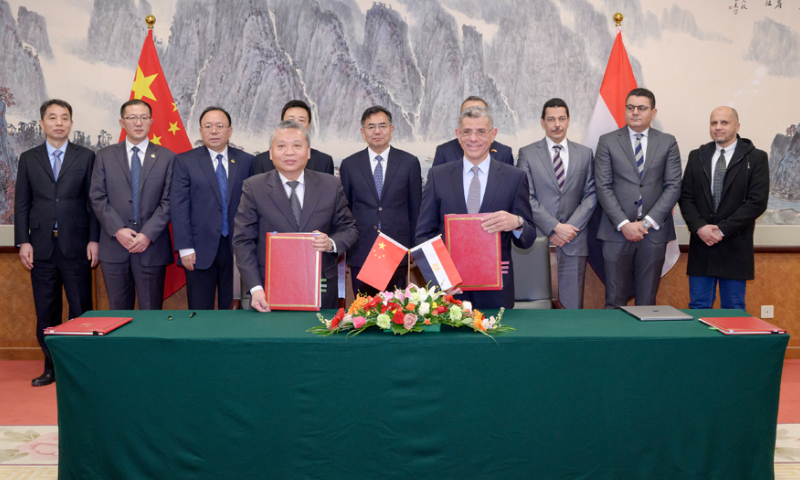
China and Egypt have signed cooperation documents in space exploration in Beijing on Wednesday to boost deep space exploration, spacecraft development and construction of space infrastructure, which is of great significance to foster a comprehensive strategic partnership between the two countries.
Zhang Kejian, administrator of the China National Space Administration (CNSA) and Sherif Sedky, Chief Operating Officer of the Egyptian Space Agency (EGSA), signed a memorandum of understanding between the governments of the two countries on space cooperation and peaceful use of outer space and a cooperation agreement between the CNSA and the EGSA on the International Lunar Research Station (ILRS).
According to the cooperation documents, both sides will encourage joint researches and development cooperation in a variety of areas including lunar and deep space exploration, development and launch of spacecraft, construction of space infrastructure, satellite data reception and application, the BRICS Remote Sensing Satellite Constellation, space science and astronomical observation.
They will also collaborate on the joint demonstration and research of the ILRS, space missions, space systems and subsystems, space equipment, ground segments and applications, education and training and capacity building.
China and Egypt have achieved fruitful results in space cooperation. The China-assisted Egyptian Satellite Assembly, Integration and Test Center completed the acceptance checks in June this year. The China-funded MisrSat-2 satellite completed its assembly and testing at the center and was launched on Monday.
The satellite MisrSat-2, launched by a Long March-2C carrier rocket from the Jiuquan Satellite Launch Center in Northwest China's Gansu Province, will be used in Egypt's land and resource utilization, water conservancy, agriculture, and other fields. It is a landmark project of deep cooperation between China and Egypt in the field of aerospace high-tech, and is of milestone significance in aerospace cooperation between the two countries, according to the CNSA.
The signing of these space agreements between China and Egypt will guide future collaboration and play a significant role in advancing space technology and fostering comprehensive strategic partnerships between the two countries, said CNSA in a press release on Wednesday.
Police in Meigu county in Liangshan, Sichuan, recently received a report from the School of Ecology and Nature Conservation, Beijing Forestry University, which said that a black-necked crane with a tracker for scientific research had remained in a static status for an extended period. The institute asked for an investigation into the condition of the migratory bird.
The police immediately formed a task force to investigate into the incident in the outskirts of a sparsely populated hamlet.
After extensive investigations and visits, the police finally tracked down the suspect surnamed Jike.
Jike confessed under interrogation that he illegally captured and killed the rare species of the endangered wildlife animal black-necked crane.
According to Jike, he happened to see the big bird resting on the river bank on his way home and the idea of catching and eating the bid just occurred to him. A thought that he soon followed up on.
According to the judicial appraisal results by a forestry judicial appraisal center in Sichuan, the bird killed by the suspect was a black-necked crane, which is one of China’s national first-class key protected animals. The tracking device tied to the bird’s foot and the serial number show that the black-necked crane was exactly the one that was used for ecological study of migration of the crane by the college institute.
Jike has been placed under criminal detention by the police for the suspicion of the crime of endangering precious and endangered wildlife animal. The case is currently under further investigation.
According to media reports, the black-necked crane is the only species of crane endemic to China and is among the 15 crane species that currently exist in the world. It is also the only crane species in the world that grows and breeds on plateaus, earning it the titles of “plateau fairy” and “plateau divine bird.”
China’s top legislature passed regulation on February 24, 2020 to strictly ban the illegal wildlife trade and eliminate bad habits of eating wild animals in China to safeguard people’s health and livelihoods.
According to China’s Criminal Law, anyone who illegally captures, kills, transports, purchases or sells national protected, precious, endangered wildlife and their products, shall be sentenced to imprisonment for up to five years or faced with criminal detention, along with a fine.
In cases of serious circumstances, the punishment may be extended to 5-10 years of imprisonment, along with a fine. In particularly severe cases, the sentence may be more than 10 years of imprisonment, along with a fine or confiscation of property and assets.
Preliminary investigation shows the separation of carriages accident along the Changping Line of Beijing subway on Thursday evening was due to the snowy weather, which affected the train's braking system, resulting in a rear-end collision with the front train, Beijing transportation authorities said on Friday.
Around 11:00 pm on Thursday, the personnel transfer was completed, and the on-site disposal work basically finished. A total of 515 people were sent to the hospital for examination, and 102 people were found to have suffered fractures, with no fatalities, the authorities said on Friday.
According to the authorities' announcement, the accident occurred as a result of the slippery tracks caused by the snowy weather. The preceding train had to make an emergency brake to stop. Unfortunately, the following train was situated in a downhill section, making it difficult to effectively brake due to the snowy conditions.
Beijing transportation authority apologized for the inconvenience, fright, and injuries caused to the passengers in this accident, and vowed to do a good job in carrying out post-accident work and conduct a comprehensive investigation to improve extreme weather operation and emergency response to ensure the safety of operations.
It was at 6:57 pm on Thursday, when a rear-end collision occurred in the section between Xi’erqi to Life Science Park stations of the Changping Line. The municipal government officials immediately went to the scene and set up a working group for on-site accident disposal. The relevant departments including transportation, firefighting, health, public security and emergency response responded quickly and made efforts for rescue, according to the authorities.
As of 6 am on Friday, 423 people have been discharged from hospital, 25 people are under observation, and 67 people are receiving hospital treatment, the authorities said.
On Friday, Beijing Subway apologized again over the incident, while putting in place measures to reduce inconvenience for passengers.
Currently, the Beijing municipal government has established an investigation team for the Changping Line accident, which will further investigate the cause of the accident, evaluate the emergency response, and learn lessons from the accident, effectively carrying out rectification measures.
The Ministry of Finance and the Ministry of Emergency Management on Tuesday have urgently allocated 200 million yuan ($28 million) in disaster relief funds to northwest China’s Gansu and Qinghai provinces. This funding will support local earthquake relief efforts and ensure the safety of people's lives and property, minimizing the impact and losses caused by the disaster, China Media Group (CMG) reported.
China is stepping up rescue and relief efforts to ensure the safety of people's lives and property after a 6.2-magnitude earthquake shook Jishishan County in northwest China's Gansu Province at midnight Monday.
The State Council has sent a working group to the stricken regions to help guide relief work. Gansu and Qinghai provinces have organized relief support with immediate allocation of relief supplies such as camps and folding beds to impacted areas.
Relief supplies were immediately redeployed from nearby areas, with supplies gradually arriving to impacted communities, China’s National Development and Reform Commission (NDRC) told a press conference on Tuesday.
The NDRC has activated emergency response mechanism to ensure energy, electricity, and essential supplies. Efforts are being made to repair damaged power facilities and provide emergency power supply. Food and material reserves are being allocated for disaster relief, a spokesperson from the NDRC said.
The first shipment of 46,100 emergency relief supplies from central and provincial level have been dispatched to the disaster-stricken areas, including cotton tents, quilts, mattresses, folding beds, cotton shoes, and stoves, according to Gansu provincial grain and material reserve bureau. The bureau has also obtained 15 tons of flour for emergency supply in Jishishan.
The State Council's earthquake relief headquarters and the Ministry of Emergency Management have upgraded the national earthquake emergency response to Level II.
At present, the earthquake has led 105 deaths in Gansu and 11 deaths in Qinghai, with damaging basic infrastructure such as water, electricity, transportation, and communications, Xinhua News Agency reported.
Rescue and relief efforts are progressing in an orderly manner, including hazard inspections, evacuation and resettlement of residents, and repair of damaged facilities, China Media Group reported.
A 512.6-meter-long ice slide makes its debut in the Changchun Ice and Snow New World in Changchun, Northeast China's Jilin Province, on December 12, 2023. The Changchun Ice and Snow New World opened its doors to visitors on December 12. Photo: VCG
The Chengdu FISU World University Games concluded on Tuesday as the hosts, the Chinese delegation, finished with 103 gold, 40 silver and 35 bronze medals to sit at the top of the medal table, setting a new record for the best results for China at a FISU Games.
The world-leading Chinese university swimming team has been the biggest contributor for China's medal haul at the Games, as the Chinese swimmers totaled 18 gold and two bronze medals.
Besides the big stars such as multiple-time gold medalists Qin Haiyang, Zhang Yufei and Li Bingjie, names such as five-time National Para Games gold medalist Peng Huidi, who faces a lasting hearing issue, also took the stage.
The Central South University student, who had to rely on a visual confirmation at the start of the race, compared to her opponents who dive into the pool after hearing the starting horn, is a slow starter in every race.
However, she had successfully improved her result in the 1,500 meters freestyle by a stunning 32.3 seconds.
Beyond the outstanding performances delivered by the Chinese delegation, which consisted of a total of 411 athletes participating in all 18 events, the tournament has a lot of memorable moments.
Communication, understanding
FISU Acting President Leonz Eder said Tuesday that Chengdu has really made all dreams come true as he reviews the Games.
"What we have witnessed here in Chengdu is state of the art. It's the best we can have. It's really fantastic for the athletes, for the spectators, for everybody," he told reporters. "There's nothing to complain about."
FISU Secretary-General Eric Saintrond believes that hosting the Chengdu Universiade has helped foster China's global image as many young people come to visit the city.
"What you see and hear is different from what people tell you," Saintrond said. "Many people have never been to Chengdu and to China."
As for the impact of the FISU Games on the youth, Acting President Eder affirmed that the Games showcased the importance of communication, understanding, and learning from different cultures.
He asserted that fostering open dialogue and embracing diverse viewpoints is key to creating a better world.
"In some parts of the world, people stopped talking to each other, but the young generation, they don't know these borders, these frontiers," Eder told the Global Times.
"They talk to each other, they learn their own stories, they tell their own stories, they start to communicate, and these are the students, because the students, they speak different languages, and they have no shy to meet other people, and this is really what we believe is needed to make a better world," Eder said of the young people of the world.
"Don't think that your opinion is the only one in the world. We have so many different opinions, different cultures, based on different histories, not one is better than the other, but go and talk to each other, learn from each other, and this is the basic for creating a better world."
Showcasing Chinese culture
The Chengdu FISU Games, the first international multi-sport tournament held in West China, have also become a platform for athletes worldwide to learn about the diverse Chinese culture.
The cultural fair is among the most popular destinations for athletes every night after their competitions.
"One of the pillars of FISU is education, culture, and sport. We do not just organize sport event. For us it is important to show the young people to give the opportunity to discover the culture, the richness of every place where we are going," Eder said.
Saintrond highlighted that after the two postponements of the originally scheduled 2021 event, the Universiade was able to provide more opportunities to students to learn about China.
Saintrond said China hosting an open Universiade, rather than in a closed loop like Tokyo Olympics and Beijing 2022 due to COVID-19, is of much significance.
"It was not only to open the [Games] Village and allow the people to go out of the Village. It is to open the door to the Chinese culture. That has been extremely important for students," he said. "The sports competition is one thing, but the people have to meet each other, have to make friends to get to learn the culture and the history of other nations."
As Chengdu moves forward to host future sports events, such as the 2025 World Games, venues and facilities as well as the volunteers and staff for the FISU Games are likely to be involved again.
"These facilities will be used not only for university students, but also for the citizens of Chengdu and the province," Eder said.
"With these fantastic facilities, you can host future games, whether it's world championships or the World Games .... It's important to use all these venues."
China's mixed martial arts (MMA) athlete Zhang Weili has once again proven that she's the best women's MMA strawweight fighter in the world with a unanimous decision win over Amanda Lemos in the co-main event at the UFC 292 on August 20.
Currently in Beijing after the fight, in which she defended her title for the first time since her second championship win, Zhang is now focused on blending Chinese culture into her future tactics.
Zhang applauded her opponent's tenacity, noting that credit is due to Lemos' persistence.
"There were a few times when I would see her eyes close when I was punching her, but later her eyes would open up again. I thought that her willpower was great," Zhang told the Global Times in an interview.
In Zhang's view, Lemos, known for her jiu-jitsu skills, is one of the most tenacious opponents she has encountered in recent years, and if the roles were reversed, she doubts she would have withstood such an onslaught of heavy punches.
"Nearly everyone thinks that I'm poor at ground skills, but I actually won the first 10 matches of my career on the ground," Zhang noted as her win came thanks to her overpowering ground-fighting skills, which involves hand-to-hand combat, against Lemos.
As far as the moniker "hexagon warrior" bestowed upon her by fans for her well-rounded skill set, Zhang considers as a humbling gesture.
"I'm yet to be a hexagon warrior but I'm trying my best to be one," Zhang said. "I think my skills, either ground skills or stand-up combat skills or agility, still need to be honed."
Tactic without tactics
She said the tactic employed against Lemos was to wrap around her "like water" and not give her too much space in any aspect. Using the "tactic without tactics" formula allows her better control of the situation.
The 34-year-old, who has dominated in nearly all of her matches outside of her two losses to Rose Namajunas of the US, has woven the tapestry of Chinese culture into her fighting approach beyond the octagon.
"Now I fight by using a tactic which does not involve any specific tactics," Zhang told the Global Times.
While on the face of it, Zhang's approach may appear strange, it is credited to the concept "Be water, my friend," famously coined by martial artist Bruce Lee, noting this philosophy guides her movements, emphasizing fluidity and adaptability in the face of adversity.
"I learned this concept at a very young age but it wasn't until recent years that I have developed a deeper understanding of what 'be water' means, which I can blend it into my tactics rather than previously trying to stick to one planned tactic," Zhang said.
She describes her fighting style as possessing both fluid and solid qualities, allowing her to be agile and efficient. Her use of traditional Chinese martial arts principles, such as the balance of yin, which means something of darkness, and yang, which means life and brightness, has given her a unique edge in the ring.
"I have benefited a lot from Chinese culture. I hope more people can learn from it and then improve themselves. It's more about studying and learning how to comprehend," she told the Global Times.
"It's important to learn from what the ancestors have left us, such as sincerity and modesty, and know how to be respectful and grateful," said Zhang.
Rose to fame
Born in Handan, a city in North China's Hebei Province, Zhang's formative years were characterized by discipline and dedication.
Zhang was introduced to martial arts at the age of 12. Little did they know that this early influence of modesty and discipline would set the stage for a remarkable athletic journey.
It was not common for girls to seriously pursue martial arts in China, but Zhang's passion burned brighter than the obstacles in her path. She trained diligently, determined to become a skilled fighter.
But it was her entry into the Ultimate Fighting Championship that truly catapulted her into the MMA spotlight.
Zhang's rise to prominence has not only made her a symbol of hope and empowerment for aspiring fighters in China but also a trailblazer in women's MMA globally. Her influence extends far beyond the ring, as she continues to inspire the next generation of fighters, both in China and around the world.
Zhang spent some time in 2022 learning tai chi from a master in her hometown.
"When I would use force while wrestling, it would always feel especially hard, but now with the idea of tai chi, everything is curved - there is rigidity and flexibility," Zhang said, noting that when incorporating Tai Chi into her training routine made her realize that wrestling also had soft qualities.
Zhang's winning form has also triggered an increasing number of young people participating in MMA in China.
It also gives pause to those who claim that championships are only built on the failures of many, which is antithetical to traditional Chinese culture's advocacy for securing victories through subduing opponents without fighting rather than an emphasis on the eventual victory.
"I don't think it is accurate to say that championships are based on the failures of many," Zhang told the Global Times.
"As long as you practice, at the very least, you will learn a lot from it," she said.
Local favorite Zhang Zhizhen beat Japan's Yosuke Watanuki 6-4, 7-6(7) at the Hangzhou Asian Games on Saturday to capture China's first men's singles gold medal in nearly three decades.
Pan Bing won the men's title for China at 1990 and 1994 Asian Games.
Another Chinese player Wu Yibing, silver medalist at Jakarta 2018, suffered an early exit after a shock third-round defeat on Tuesday.
The Week of Italian Cuisine in the World kicked off on Monday, with the aim to promote exquisite Italian cooking, the Mediterranean diet, Italian agri-food products and wine. In the 2023 edition, as in past years, the week will be further enhanced by activities organized by the Italian Embassy in China together with the Italian business community operating in China.
Several Italian restaurants in Beijing, Tianjin, and Qingdao have been preparing special menus and typical dishes for Chinese friends and expatriates residing in China to enjoy throughout the Italian cuisine week that is set to run until November 19. Beijing's ABBOCCA restaurant, for instance, has provided a special selection for homemade fresh cheeses called "TRILOGY," which includes mozzarella, stracciatella, and ricotta, and has been dubbed a tasty journey through salty and sweet to stimulate all senses complete with fresh basil leaves, cherry tomatoes.
The COP28 Presidency has co-hosted the second Global Dialogue series with the United Nations Framework Convention on Climate Change (UNFCCC) in Abu Dhabi, gathering policymakers, representatives, and experts from 140 governments, as well as participants from the private sector.
The Global Dialogue, held in Abu Dhabi Global Market from 15-17 October, is the largest UNFCCC mandated event held in the emirate to date, and focused on accelerating the energy transition and decarbonization of the transportation sector.
Those attending, including COP28 Chief Executive Officer Adnan Z Amin, drove technical alignment and produced a report that will help jumpstart upcoming discussions at Pre-COP from 30-31 October, where up to 100 ministers will discuss key priorities in Abu Dhabi for COP28.
Attendees agreed that decarbonizing the transportation system will make a significant contribution to a just and equitable energy transition, and will boost economic diversification by creating green jobs and invigorating industries in developing countries.
Solutions discussed for decarbonizing transportation included the deployment and shift to collective and non-motorized transportation models, energy and resource efficiency in the transportation sector, vehicle electrification, and the adoption of low- or zero-carbon fuels.
A sustainable transport sector is central to our shared success in keeping 1.5°C within reach,” Mr. Amin said at the event. According to the IPCC’s sixth assessment report, the transport sector emits 8.7Gt per year, representing roughly 23 percent of global emissions, he said, so “transport would need an accelerated electrification and associated deployment of charging infrastructure in the coming decades.”