When it’s playtime, many kids prefer reality over fantasy

Young children travel to fantasy worlds every day, packing just imaginations and a toy or two.

Some preschoolers scurry across ocean floors carrying toy versions of cartoon character SpongeBob SquarePants. Other kids trek to distant universes with miniature replicas of Star Wars robots R2-D2 and C-3PO. Throngs of youngsters fly on broomsticks and cast magic spells with Harry Potter and his Hogwarts buddies. The list of improbable adventures goes on and on.

Parents today take for granted that kids need toys to fuel what comes naturally — outlandish bursts of make-believe. Kids’ flights of fantasy are presumed to soar before school and life’s other demands yank the youngsters down to Earth.
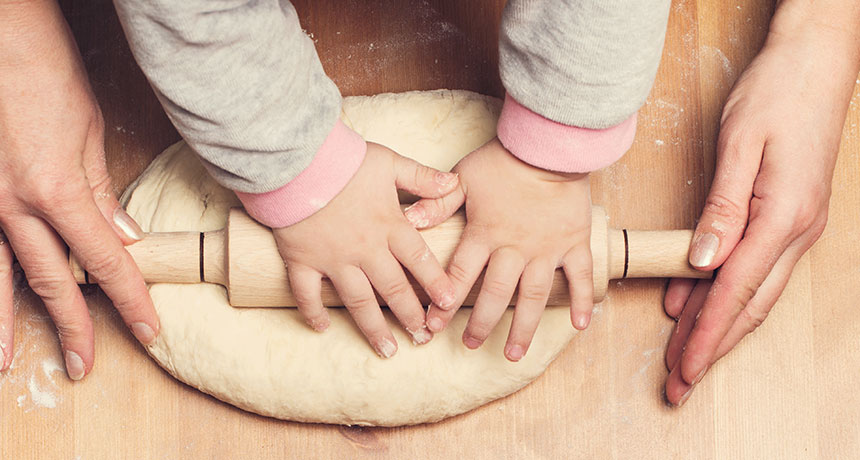
Yet some researchers call childhood fantasy play — which revolves around invented characters and settings with no or little relationship to kids’ daily lives — highly overrated. From at least the age when they start talking, little ones crave opportunities to assist parents at practical tasks and otherwise learn how to be productive members of their cultures, these investigators argue.

New findings support the view that children are geared more toward helping than fantasizing. Preschoolers would rather perform real activities, such as cutting vegetables or feeding a baby, than pretend to do those same things, scientists say. Even in the fantastical realm of children’s fiction books, reality may have an important place. Young U.S. readers show signs of learning better from human characters than from those ever-present talking pigs and bears.
Studies of children in traditional societies illustrate the dominance of reality-based play outside modern Western cultures. Kids raised in hunter-gatherer communities, farming villages and herding groups rarely play fantasy games. Children typically play with real tools, or small replicas of tools, in what amounts to practice for adult work. Playgroups supervised by older children enact make-believe versions of what adults do, such as sharing hunting spoils.
These activities come much closer to the nature of play in ancient human groups than do childhood fantasies fueled by mass-produced toys, videos and movies, researchers think.
Handing over household implements to toddlers and preschoolers and letting them play at working, or allowing them to lend a hand on daily tasks, generates little traction among Western parents, says psychologist Angeline Lillard of the University of Virginia in Charlottesville. Many adults, leaning heavily on adult-supervised playdates, assume preschoolers and younger kids need to be protected from themselves. Lillard suspects that preschoolers, whose early helping impulses get rebuffed by anxious parents, often rebel when told to start doing household chores a few years later.

“Kids like to do real things because they want a role in the real world,” Lillard says. “Our society has gone overboard in stressing the importance of pretense and fantasy for young children.”

Keep it real
Lillard suspects most preschoolers agree with her.

More than 40 years of research fails to support the widespread view that playing pretend games generates special social or mental benefits for young children, Lillard and colleagues wrote in a 2013 review in Psychological Bulletin. Studies that track children into their teens and beyond are sorely needed to establish any beneficial effects of pretending to be other people or acting out imaginary situations, the researchers concluded.

Even the assumption that kids naturally gravitate toward make-believe worlds may be unrealistic. When given a choice, 3- to 6-year-olds growing up in the United States — one of many countries saturated with superhero movies, video games and otherworldly action figures — preferred performing real activities over pretending to do them, Lillard and colleagues reported online June 20 in Developmental Science.
One hundred youngsters, most of them white and middle class, were tested either in a children’s museum, a preschool or a university laboratory. An experimenter showed each child nine pairs of photographs. Each photo in a pair featured a boy or a girl, to match the sex of the youngster being tested. One photo showed a child in action. Depicted behaviors included cutting vegetables with a knife, talking on a telephone and bottle-feeding a baby. In the second photo, a different child pretended to do what the first child did for real.

When asked by the experimenter whether they would rather, say, cut real vegetables with a knife like the first child or pretend to do so like the second child, preschoolers chose the real activity almost two-thirds of the time. Among the preschoolers, hard-core realists outnumbered fans of make-believe, the researchers found. Whereas 16 kids always chose real activities, only three wanted to pretend on every trial. Just as strikingly, 48 children (including seven of 26 of the 3-year-olds) chose at least seven real activities of the nine depicted. Only 14 kids (mostly the younger ones) selected at least seven pretend activities.

Kids often said they liked real activities for practical reasons, such as wanting to learn how to feed babies to help mom. Hands-on activities also got endorsed for being especially fun or novel. “I’ve never talked on the real phone,” one child explained. Reasons for choosing pretend activities centered on being afraid of the real activity or liking to pretend.

In a preliminary follow-up study directed by Lillard, 16 girls and boys, ages 3 to 6, chose between playing with 10 real objects, such as a microscope, or toy versions of the same objects. During 10-minute play periods, kids spent an average of about twice as much time with real items. That preference for real things increased with age. Three-year-olds spent nearly equal time playing with genuine and pretend items, but the older children strongly preferred the real deal.

Lillard’s findings illustrate that kids want and need real experiences, says psychologist Thalia Goldstein of George Mason University in Fairfax, Va. “Modern definitions of childhood have swung too far toward thinking that young children should live in a world of fantasy and magic,” she maintains.

But pretend play, including fantasy games, still has value in fostering youngsters’ social and emotional growth, Goldstein and Matthew Lerner of Stony Brook University in New York reported online September 15 in Developmental Science. After participating in 24 play sessions, 4- and 5-year-olds from poor families were tested on empathy and other social skills. Those who played dramatic pretend games (being a superhero, animal or chef, for instance) were less likely than kids who played with blocks or read stories to become visibly upset upon seeing an experimenter who the kids believed had hurt a knee or finger, the researchers found. Playing pretend games enabled kids to rein in distress at seeing the experimenter in pain, the researchers proposed.

It’s not known whether fantasy- and reality-based games shape kids’ social skills in different ways over the long haul, Goldstein says.

True fiction
Even on the printed page, where youngsters gawk at Maurice Sendak’s goggle-eyed Wild Things and Dr. Seuss’ mustachioed Lorax, the real world exerts a special pull.

Consider 4- to 6-year-olds who were read either a storybook about a little raccoon that learns to share with other animals or the same storybook with illustrations of human characters learning to share. Both versions told of how characters felt better after giving some of what they had to others. A third set of kids heard an illustrated storybook about seeds that had nothing to do with sharing. Each group consisted of 32 children.

Only kids who heard the realistic story displayed a general willingness to act on its message, reported a team led by psychologist Patricia Ganea of the University of Toronto in a paper published online August 2 in Developmental Science. On a test of children’s willingness to share any of 10 stickers with a child described as unable to participate in the experiment, listeners to the tale with human characters forked over an average of nearly three stickers, about one more than the kids had donated before the experiment.

Children who heard stories with animal characters became less giving, sharing an average of 1.7 stickers after having originally donated an average of 2.3 stickers. Sticker sharing declined similarly among kids who heard the seed story. These results fit with several previous studies showing that preschoolers more easily apply knowledge learned from realistic stories to the real world, as opposed to information encountered in fantasy stories.

Even for fiction stories that are highly unrealistic, youngsters generally favor realistic endings, say Boston University psychologist Melissa Kibbe and colleagues. In a study from the team published online June 15 in Psychology of Aesthetics, Creativity and the Arts, an experimenter read 90 children, ages 4 to 6, one of three illustrated versions of a story. In the tale, a child gets lost on the way to a school bus. A realistic version was set in a present-day city. A futuristic science fiction version was set on the moon. A fantasy version occurred in medieval times and included magical characters. Stories ended with descriptions and illustrations of a child finally locating either a typical school bus, a futuristic school bus with rockets on its sides or a magical coach with dragon wings.
When given the chance, 40 percent of kids inserted a typical school bus into the ending for the science fiction story and nearly 70 percent did so for the fantasy tale. “Children have a bias toward reality when completing stories,” Kibbe says.
Hands on
Outside Western cultures, children’s bias toward reality takes an extreme turn, especially during play.

Nothing keeps it real like a child merrily swinging around a sharp knife as adults go about their business. That’s cause for alarm in Western households. But in many foraging communities, children play with knives and even machetes with their parents’ blessing, says anthropologist David Lancy of Utah State University in Logan.

Lancy describes reported instances of youngsters from hunter-gatherer groups playing with knives in his 2017 book Raising Children. Among Maniq foragers inhabiting southern Thailand’s forests, for instance, one researcher observed a father looking on approvingly as his baby crawled along holding a knife about as long as a dollar bill. The same investigator observed a 4-year-old Maniq girl sitting by herself cutting pieces of vegetation with a machete.

In East Africa, a Hadza infant can grab a knife and suck on it undisturbed, at least until an adult needs to use the tool. On Vanatinai Island in the South Pacific, children freely experiment with knives and pieces of burning wood from campfires.

Yes, accidents happen. That doesn’t mean hunter-gatherer parents are uncaring or indifferent toward their children, Lancy says. In these egalitarian societies, where sharing food and other resources is the norm, parents believe it’s wrong to impose one’s will on anyone, including children. Hunter-gatherer adults assume that a child learns best through hands-on, sometimes risky, exploration on his or her own and in groups with other kids. In that way, the adults’ thinking goes, youngsters develop resourcefulness, creativity and determination. Self-inflicted cuts and burns represent learning opportunities.

In many societies, adults make miniature tools for children to play with or give kids cast-off tools to use as toys. For instance, Inuit boys have been observed mimicking seal hunts with items supplied by parents, such as pieces of sealskin and miniature harpoons. Girls in Ecuador’s Conambo tribe mold clay balls provided by their mothers into various shapes as a first step toward becoming potters.
Childhood games and toys in foraging groups and farming villages, as in Western nations, reflect cultural values. Hunter-gatherer kids rarely engage in rough-and-tumble or competitive games. In fact, competition is discouraged. These kids concoct games with no winners, such as throwing a weighted feather in the air and flicking the feather back up as it descends. Children in many farming villages and herding societies play basic forms of marbles, in which each player shoots a hard object at similar objects to knock the targets out of a defined area. The rules change constantly as players decide among themselves what counts and what doesn’t.

Children in traditional societies don’t invent fantasy characters to play with, Lancy says. Consider imaginative play among children of Aka foragers in the Central African Republic. These kids may pretend to be forest animals, but the animals are creatures from the children’s surroundings, such as antelope. The children aim to take the animals’ perspective to determine what route to follow while exploring, says anthropologist Adam Boyette of Duke University. Aka youngsters sometimes pretend to be spirits that adults have told the kids about. In this way, kids become familiar with community beliefs and rituals.
Aka childhood activities are geared toward adult work, Boyette says. Girls start foraging for food within the first few years of life. Boys take many years to master dangerous tasks, such as climbing trees to raid honey from bees’ nests (SN: 8/20/16, p. 10). By around age 7, boys start to play hunting games and graduate to real hunts as teenagers.

In 33 hunter-gatherer societies around the world, parents typically take 1- to 2-year-olds on foraging expeditions and give the youngsters toy versions of tools to manipulate, reported psychologist Sheina Lew-Levy of the University of Cambridge and her colleagues in the December Human Nature. Groups of children at a range of ages play make-believe versions of what adults do and get in some actual practice at tasks such as toolmaking. Youngsters generally become proficient food collectors and novice toolmakers between ages 8 and 12, the researchers conclude. Adults, but not necessarily parents, begin teaching hunting and complex toolmaking skills to teens. For the report, Lew-Levy’s group reviewed 58 papers on childhood learning among hunter-gatherers, most published since 2000.

“There’s a blurred line between work and play in foraging societies because children are constantly rehearsing for adult roles by playing,” Boyette says.

Children in Western societies can profitably mix fantasy with playful rehearsals for adult tasks, observes George Mason’s Goldstein, who was a professional stage actor before opting for steadier academic work. “My 5-year-old son is never happier than when he’s helping to check us out at the grocery store,” she says. “But he also likes to pretend to be a robot, and sometimes a robot who checks us out at the grocery store.”

Not too far in the future, preschoolers pretending to be robots may encounter real robots running grocery-store checkouts. Playtime will never be the same.

By 2100, damaged corals may let waves twice as tall as today’s reach coasts

A complex coral reef full of nooks and crannies is a coastline’s best defense against large ocean waves. But coral die-offs over the next century could allow taller waves to penetrate the corals’ defenses, simulations suggest. A new study finds that at some Pacific Island sites, waves reaching the shore could be more than twice as high as today’s by 2100.

The rough, complex structures of coral reefs dissipate wave energy through friction, calming waves before they reach the shore. As corals die due to warming oceans (SN: 2/3/18, p. 16), the overall complexity of the reef also diminishes, leaving a coast potentially more exposed. At the same time, rising sea levels due to climate change increasingly threaten low-lying coastal communities with inundation and beach erosion — and stressed corals may not be able to grow vertically fast enough to match the pace of sea level rise. That could also make them a less effective barrier.

Researchers compared simulations of current and future sea level and reef conditions at four sites with differing wave energy near the French Polynesian islands of Moorea and Tahiti. The team then simulated the height of a wave after it has passed the reef, known as the back-reef wave height, under several scenarios. The most likely scenario studied was based on the Intergovernmental Panel on Climate Change’s projections of sea level height by 2100 and corresponding changes in reef structure.

Under those conditions, the average back-reef wave heights at the four sites would be 2.4 times as high in 2100 as today, the team reports February 28 in Science Advances. That change would be largely due to the decrease in coral reef complexity rather than rising sea levels, the simulations suggest. Coastal communities around the world will likely see similar wave height increases, dependent on local reef structures and extent of sea level rise. The finding, the researchers say, shows that conserving reefs is crucial to protecting coastal communities in a changing climate.

Forget Pi Day. We should be celebrating Tau Day

As a physics reporter and lover of mathematics, I won’t be celebrating Pi Day this year. That’s because pi is wrong.

I don’t mean that the value is incorrect. Pi, known by the symbol π, is the number you get when you divide a circle’s circumference by its diameter: 3.14159… and so on without end. But, as some mathematicians have argued, the mathematical constant was poorly chosen, and students worldwide continue to suffer as a result.

A longtime fixture of high school math classes, pi has inspired books, art (SN Online: 5/4/06) and enthusiasts who memorize it to tens of thousands of decimal places (SN: 4/7/12, p. 12). But some contend that replacing pi with a different mathematical constant could make trigonometry and other math subjects easier to learn. These critics — including myself — advocate for an arguably more elegant number equal to 2π: 6.28318…. Sometimes known as tau, or the symbol τ, the quantity is equal to a circle’s circumference divided by its radius, not its diameter.

This idea is not new. In 2001, mathematician Bob Palais of the University of Utah in Salt Lake City published an article in the Mathematical Intelligencer titled “ π is wrong!” The topic gained more attention in 2010 with The Tau Manifesto, posted online by author and educator Michael Hartl. But the debate tends to reignite every year on March 14, which is celebrated as Pi Day for its digits: 3/14.
The simplest way to see the failure of pi is to consider angles, which in mathematics are typically measured in radians. Pi is the number of radians in half a circle, not a whole circle. That makes things confusing: For example, the angle at the tip of a slice of pizza — an eighth of a pie — isn’t π/8, but π/4. In contrast, using tau, the pizza-slice angle is simply τ/8. Put another way, tau is the number of radians in a full circle.

That factor of two is a big deal. Trigonometry — the study of the angles and lines found in shapes such as triangles — can be a confusing whirlwind for students, full of blindly plugging numbers into calculators. That’s especially true when it comes to sine and cosine, two important functions in trigonometry. Many trigonometry problems involve calculating the sine or cosine of an angle. When graphed, the two functions look like a series of wiggles, shaped a bit like an “S” on its side, that repeat the same values every 2π. That means pi covers only half of an S. Tau, on the other hand, covers the full wiggle, a more intuitive measure.

Pi has become so embedded in mathematics that it could be hard to excise. A more practical approach may be to introduce tau as a teaching tool alongside pi, rather than a replacement. Education is where tau’s impact is most likely to be felt: Professional scientists and mathematicians can comfortably handle the factors of two that crop up with pi in equations.

You might argue that multiplying by two isn’t that hard, even for students. But it isn’t the arithmetic that concerns me. Trigonometry is notorious for creating a divide between the math-fluent and math-phobic. But helping more people understand and enjoy mathematics isn’t some pie-in-the-sky fantasy. Everyone is capable of doing math. We just need to work smarter, and speak more clearly, to help those who struggle.

So here’s to June 28 — Tau Day.

The great Pacific garbage patch may be 16 times as massive as we thought

We’re going to need a bigger trash can.

A pooling of plastic waste floating in the ocean between California and Hawaii contains at least 79,000 tons of material spread over 1.6 million square kilometers, researchers report March 22 in Scientific Reports. That’s the equivalent to the mass of more than 6,500 school buses. Known as the great Pacific garbage patch, the hoard is four to 16 times as heavy as past estimates.

About 1.8 trillion plastic pieces make up the garbage patch, the scientists estimate. Particles smaller than half a centimeter, called microplastics, account for 94 percent of the pieces, but only 8 percent of the overall mass. In contrast, large (5 to 50 centimeters) and extra-large (bigger than 50 centimeters) pieces made up 25 percent and 53 percent of the estimated patch mass.
Much of the plastic in the patch comes from humans’ ocean activities, such as fishing and shipping, the researchers found. Almost half of the total mass, for example, is from discarded fishing nets. A lot of that litter contains especially durable plastics, such as polyethylene and polypropylene, which are designed to survive in marine environments.
To get the new size and mass estimates, Laurent Lebreton of the Ocean Cleanup, a nonprofit foundation in Delft, the Netherlands, and his colleagues trawled samples from the ocean surface, took aerial images and simulated particle pathways based on plastic sources and ocean circulation.
Aerial images provided more accurate tallies and measurements of the larger plastic pieces, the researchers write. That could account for the increase in mass over past estimates, which relied on trawling data and images taken from boats, in addition to computer simulations. Another possible explanation: The patch grew — perhaps driven by an influx of debris from the 2011 tsunami that hit Japan and washed trash out to sea (SN: 10/28/17, p. 32).

The mystery of Christiaan Huygens’ flawed telescopes may have been solved

17th century scientist Christiaan Huygens set his sights on faraway Saturn, but he may have been nearsighted.

Huygens is known, in part, for discovering Saturn’s largest moon, Titan, and deducing the shape of the planet’s rings. But by some accounts, the Dutch scientist’s telescopes produced fuzzier views than others of the time despite having well-crafted lenses.

That may be because Huygens needed glasses, astronomer Alexander Pietrow proposes March 1 in Notes and Records: the Royal Society Journal of the History of Science.
To make his telescopes, Huygens combined two lenses, an objective and an eyepiece, positioned at either end of the telescope. Huygens experimented with different lenses to find combinations that, to his eye, created a sharp image, eventually creating a table to keep track of which combinations to use to obtain a given magnification. But when compared with modern-day knowledge of optics, Huygens’ calculations were a bit off, says Pietrow, of the Leibniz Institute for Astrophysics Potsdam in Germany.

One possible explanation: Huygens selected lenses based on his flawed vision. Historical records indicate that Huygens’ father was nearsighted, so it wouldn’t be surprising if Christiaan Huygens also suffered from the often-hereditary affliction.

Assuming that’s the reason for the mismatch, Pietrow calculates that Huygens had 20/70 vision: What someone with normal vision could read from 70 feet away, Huygens could read only from 20 feet. If so, that could be why Huygens’ telescopes never quite reached their potential.

50 years ago, atomic testing created otter refugees

Sea otters restocked in old home

When the [Atomic Energy Commission] first cast its eye on the island of Amchitka as a possible site for the testing of underground nuclear explosions, howls of anguish went up; the island is part of the Aleutians National Wildlife Refuge, created to preserve the colonies of nesting birds and some 2,500 sea otters that live there…— Science News, November 9, 1968

Update
The commission said underground nuclear testing would not harm the otters, but the fears of conservationists were well-founded: A test in 1971 killed more than 900 otters on the Aleutian island.
Some otters remained around Amchitka, but 602 otters were relocated in 1965–1972 to Oregon, southeast Alaska, Washington and British Columbia — areas where hunting had wiped them out. All but the Oregon population thrived, and today more than 25,000 otters live near the coastal shores where once they were extinct.

“They were sitting on the precipice,” says James Bodkin, who is a coastal ecologist at the U.S. Geological Survey. “It’s been a great conservation story.”

Martian soil may have all the nutrients rice needs

THE WOODLANDS, TEXAS — Martian dirt may have all the necessary nutrients for growing rice, one of humankind’s most important foods, planetary scientist Abhilash Ramachandran reported March 13 at the Lunar and Planetary Science Conference. However, the plant may need a bit of help to survive amid perchlorate, a chemical that can be toxic to plants and has been detected on Mars’ surface (SN: 11/18/20).

“We want to send humans to Mars … but we cannot take everything there. It’s going to be expensive,” says Ramachandran, of the University of Arkansas in Fayetteville. Growing rice there would be ideal, because it’s easy to prepare, he says. “You just peel off the husk and start boiling.”
Ramachandran and his colleagues grew rice plants in a Martian soil simulant made of Mojave Desert basalt. They also grew rice in pure potting mix as well as several mixtures of the potting mix and soil simulant. All pots were watered once or twice a day.

Rice plants did grow in the synthetic Mars dirt, the team found. However, the plants developed slighter shoots and wispier roots than the plants that sprouted from the potting mix and hybrid soils. Even replacing just 25 percent of the simulant with potting mix helped heaps, they found.

The researchers also tried growing rice in soil with added perchlorate. They sourced one wild rice variety and two cultivars with a genetic mutation — modified for resilience against environmental stressors like drought — and grew them in Mars-like dirt with and without perchlorate (SN: 9/24/21).

No rice plants grew amid a concentration of 3 grams of perchlorate per kilogram of soil. But when the concentration was just 1 gram per kilogram, one of the mutant lines grew both a shoot and a root, while the wild variety managed to grow a root.

The findings suggest that by tinkering with the successful mutant’s modified gene, SnRK1a, humans might eventually be able to develop a rice cultivar suitable for Mars.

Biologists are one step closer to creating snake venom in the lab

SAN DIEGO — Labs growing replicas of snakes’ venom glands may one day replace snake farms.

Researchers in the Netherlands have succeeded in growing mimics of venom-producing glands from multiple species of snakes. Stem cell biologist Hans Clevers of the Hubrecht Institute in Utrecht, the Netherlands, reported the creation of these organoids on December 10 at a joint meeting of the American Society for Cell Biology and the European Molecular Biology Organization.

If scientists can extract venom from the lab-grown glands, that venom might be used to create new drugs and antidotes for bites including from snakes that aren’t currently raised on farms.

Up to 2.7 million people worldwide are estimated to be bitten by venomous snakes each year. Between about 81,000 to 138,000 people die as a result of the bite, and as many as roughly 400,000 may lose limbs or have other disabilities, according to the World Health Organization.
Antivenoms are made using venom collected from snakes usually raised on farms. Venom is injected into other animals that make antibodies to the toxins. Purified versions of those antibodies can help a bitten person recover, but must be specific to the species of snake that made the bite. “If it’s a fairly rare or local snake, chances are there would be no antidote,” Clevers says.

Three postdoctoral researchers in Clevers’ lab wanted to know if they could make organoids — tissues grown from stem cells to have properties of the organs they mimic — from snakes and other nonmammalian species. The researchers started with Cape coral snakes (Aspidelaps lubricus) that were dissected from eggs just before hatching. Stem cells taken from the unhatched snakes grew into several different types of organoids, including some that make venom closely resembling the snake’s normal venom, Clevers reported at the meeting.

His team has produced venom-gland organoids from at least seven species of snakes. The organoids have survived in the lab for up to two years so far.

Clevers and colleagues hope to harvest venom from the organoids, which produce more highly concentrated venom than snakes usually make. “It’s probably going to be easier than milking a snake,” he says.

Satellites make mapping hot spots of ammonia pollution easier

Satellites may be a more accurate way to track smog-producing ammonia.

It’s notoriously tricky to pinpoint accurate numbers for ammonia gas emissions from sources such as animal feedlots and fertilizer plants. But new maps, generated from infrared radiation measurements gathered by satellites, reveal global ammonia hot spots in greater detail than before. The new data suggest that previous estimates underestimate the magnitude of these emissions, researchers report December 5 in Nature.

In the atmosphere, ammonia, which contains nitrogen, can help form tiny particles that worsen air quality and harm human health. The research could help keep tabs on who’s emitting how much, to make sure that factories and farms are meeting environmental standards.
Emissions are usually estimated by adding up output from individual known sources of activity, but those calculations are only as good as the data that go into them. Ammonia sticks around only hours to a few days in the atmosphere, so on-the-ground measurements vary a lot even in the same place, says coauthor Martin Van Damme, an atmospheric scientist at the Université Libre de Bruxelles in Belgium.

“There’s so much uncertainty in ammonia emissions,” says Daven Henze, a mechanical engineer at the University of Colorado Boulder who wasn’t part of the research. Other scientists, including his research group, have estimated ammonia releases using satellite data before. But these new maps rely on a more detailed dataset and have substantially better resolution, Henze says — fine enough that the study authors were able to link areas of high emissions to specific factories or farms.
The new maps show 248 nitrogen emission hot spots across the globe at a resolution of about a kilometer. Eighty-three of those hot spots arose from agricultural activity that involved high numbers of cows, pigs and chickens, such as a site in Colorado that overlapped on satellite imagery maps with two big cattle feedlots. Ammonia emissions from feedlots come largely from livestock waste. Another 158 sites were affected by industrial emissions — mostly from sites that produced ammonia-based fertilizer, such as in Marvdasht, Iran. Six hot spots couldn’t be pinned to specific activity.
Ammonia is also emitted naturally, from volcanoes or seabird colonies. But most of those sources were too weak or not concentrated enough to show up as hot spots in the data. Lake Natron in Tanzania is the one exception — its mud flats show up as an ammonia-releasing hot spot, perhaps due to decaying algae. But it’s not clear why other lakes with similar mud flats didn’t. Some natural sources may have gone undetected because of where they were located — in places with heavy cloud cover that obscured the data, or where turbulent air dissipated ammonia especially quickly, Van Damme suggests.

Some areas with particularly high overall ammonia emissions from biomass burning or fertilizer, such as West Africa and the Indus Valley in Pakistan and northern India, didn’t reveal specific hot spots, either, the researchers report.

U.S. fentanyl deaths are rising fastest among African-Americans

Since people in the United States began dying in the fentanyl-related drug overdose epidemic, whites have been hit the hardest. But new data released March 21 by the Centers for Disease Control and Prevention show that African-Americans and Hispanics are catching up.

Non-Hispanic whites still experience the majority of deaths involving fentanyl, a synthetic opioid. But among African-Americans and Hispanics, death rates rose faster from 2011 to 2016. Whites experienced a 61 percent annual increase, on average, while the rate rose 140.6 percent annually for blacks and 118.3 percent per year for Hispanics. No reliable data were available for other racial groups.
Overall, the number of U.S. fentanyl-related deaths in 2011 and 2012 hovered just above 1,600. A sharp increase began in 2013, reaching 18,335 deaths in 2016. That’s up from 0.5 deaths per 100,000 people in 2011 to 5.9 per 100,000 in 2016.

In the first three years of the data, men and women died from fentanyl-related overdoses at similar rates, around 0.5 per 100,000. But in 2013, those paths diverged, and by 2016, the death rate among men was 8.6 per 100,000; for women it was 3.1 per 100,000. Overdose death rates rose most sharply along the East Coast, including in New England and the middle Atlantic, and in the Great Lakes region.

One of the most powerful opioids, fentanyl has been around for decades and is still prescribed to fight pain. But it has emerged as a street drug that is cheap to make and is found mixed into other drugs. In 2013, fentanyl was the ninth most common drug involved in overdose deaths, according to the CDC report; in 2016, it was number one. Just a little bit can do a lot of damage: The drug can quickly kill a person by overwhelming several systems in the body (SN: 9/3/2016, p. 14).